







1. Three Dilemmas of Nepal's Mountain Infrastructure: Challenges in Terrain, Cost & Supply
About 75% of Nepal's territory is mountainous or hilly, with infrastructure projects such as highways, bridges, and rural housing mostly distributed on steep slopes or remote valleys. These projects have an urgent demand for infrastructure aggregates (5-30mm), but local aggregate production has long been plagued by three major challenges: First, terrain limits efficiency: Raw stones from mountain quarries are mostly hard rocks like basalt and granite, and transportation routes are narrow and winding. Traditional crushers have a low crushing ratio (only 5-8), requiring 2-3 refeedings and re-crushings to produce qualified aggregates. This not only prolongs the production cycle but also increases the frequency of raw stone transportation (transportation cost per ton of raw stone exceeds 200 Nepalese Rupees); Second, high costs: Energy supply in mountainous areas mainly relies on diesel generators (diesel price is about 150 Nepalese Rupees/liter). The high energy consumption of traditional equipment (12-15 liters of diesel per hour) makes fuel costs account for over 35% of total costs. Additionally, separate equipment for "rock crushing" and "sand making" is required, which small and medium-sized enterprises can hardly afford; Third, easy supply interruption: Traditional equipment has short service life of wear-resistant parts (high-manganese steel jaw plates only last 300 hours), and there is a shortage of professional maintenance personnel in mountainous areas, leading to frequent equipment failures. A mountain highway project once delayed construction by 2 months due to aggregate supply interruption, paying an additional liquidated damages of over 500,000 Nepalese Rupees. Against this backdrop, a crusher that can adapt to mountainous environments and combines "high crushing ratio for cost reduction" and "multi-scenario adaptability" has become the key to solving Nepal's infrastructure dilemma.
2. High Crushing Ratio: From "Repeated Refeeding" to "One-Time Forming", Breaking Mountain Efficiency Bottlenecks
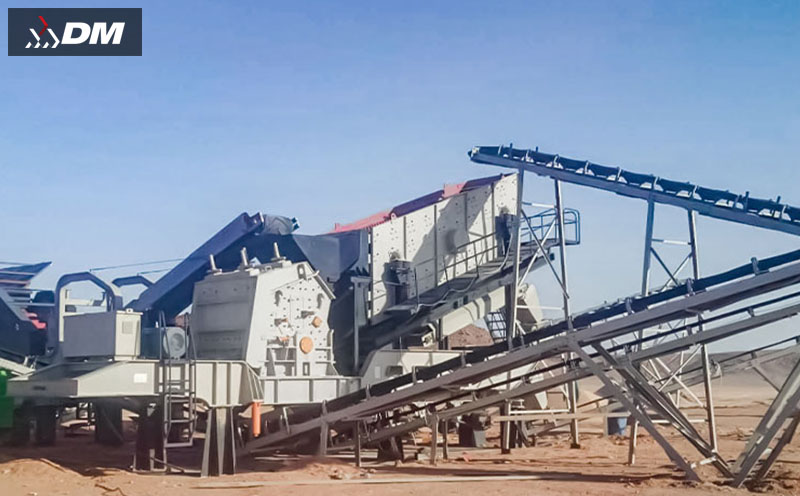
With a high crushing ratio (16-22), this crusher is designed for the characteristics of high hard rock content and difficult transportation in Nepal's mountains. It realizes "one-time crushing of large raw stones into qualified aggregates", completely eliminating the refeeding process and reducing costs from three aspects: energy consumption, labor, and transportation.
1. One-Time Forming Saves Energy: Reducing Energy Waste & Diesel Expenses
When mountain projects process basalt raw stones over 1000mm, traditional equipment requires multiple refeedings, each consuming an additional 15%-20% of diesel; relying on a reinforced crushing chamber and a high-power motor, this crusher can crush hard rocks into 15-30mm highway aggregates in one go, reducing the refeeding rate to less than 5%. The diesel consumption per ton of aggregates decreases from 0.8 liters (traditional equipment) to 0.5 liters. A mountain highway project near Pokhara consumed 120 liters of diesel per day with traditional equipment; after switching to this crusher, the daily diesel consumption was only 75 liters. Calculated based on 25 working days per month, it saves over 168,000 Nepalese Rupees in monthly diesel costs and a total of over 2 million Rupees in energy costs during the project construction period.
2. Fewer Processes Improve Efficiency: Shortening Cycles & Reducing Transportation & Labor Costs
The elimination of the refeeding process simplifies the production process from "crushing-refeeding-re-crushing" to "one-time crushing-finished product", shortening the production cycle by 60%. At the same time, there is no need for dedicated personnel for refeeding transportation, reducing labor demand by 1 worker per shift (monthly salary of mountain technical workers exceeds 40,000 Nepalese Rupees). The frequency of raw stone transportation is reduced by 50%, saving over 80,000 Rupees in monthly transportation costs. A sand and gravel yard in Lumbini previously required 3 workers to take shifts (1 for operation, 2 for refeeding and transportation) with a daily aggregate output of 400 tons; after adopting this crusher, only 2 workers can complete production, with the daily output increased to 700 tons, fully meeting the needs of 3 surrounding rural housing projects.
3. Multi-Scenario Adaptability: One Machine Equals Three, Solving Mountain Equipment Investment Problems
Relying on modular design and intelligent adaptation technology, this crusher can flexibly meet three core scenarios in Nepal's mountains: "infrastructure aggregates, building sand, and mining materials". No additional special equipment needs to be purchased, significantly reducing the initial investment of mountain enterprises.
1. Infrastructure Scenario: Efficient Production of Hard Rock Aggregates
Targeting the particle shape requirements of highways and bridges, the equipment adopts an "integrated crushing + shaping" design. Hard rocks have round particle shapes (flakiness content ≤8%) after crushing, which can be directly used for concrete mixing without additional shaping. For a bridge project in the Kathmandu Valley, the aggregate qualification rate increased from 70% (traditional equipment) to 95% after using this crusher, avoiding pier rework caused by poor aggregate quality and saving over 300,000 Nepalese Rupees in rework costs.
2. Building Materials Scenario: Flexible Switch to Sand Making Mode
Rural housing construction in mountainous areas requires a large amount of building sand (0-5mm). This crusher can crush soft rocks such as limestone and marble into high-quality sand in one go by simply installing a detachable impact sand making module, without purchasing a separate sand making machine. A building materials factory in the Bagmati Zone previously needed 2 machines to produce aggregates and sand separately, with an equipment investment of over 8 million Nepalese Rupees; after switching to this crusher, a single machine adapts to dual scenarios, reducing equipment costs by 50% and increasing sand yield by 25%.
3. Mining Scenario: Adapting to Multiple Minerals in Mountains
Nepal's mountains are rich in gold mines, limestone mines, etc. Equipped with a PLC intelligent control system, this crusher can real-time identify mineral hardness (such as gold-associated hard rock and limestone soft rock) and automatically adjust crushing pressure, eliminating the need for manual sorting of mixed ores. A gold mine in Manang District had a daily processing capacity of only 200 tons with traditional equipment when handling associated granite; after adopting this crusher, the daily processing capacity increased to 450 tons, and the crushed minerals had uniform particle sizes, facilitating subsequent mineral processing.
4. Stable Supply Guarantee: Durability & Easy Maintenance, Adapting to Mountain Environments
Targeting the difficulties of maintenance and complex environments in Nepal's mountains, the equipment enhances durability from material and structure aspects to ensure stable aggregate supply.
- Composite Wear-Resistant Parts: Extending Service Life & Reducing Maintenance: Core wear-resistant parts are made of "high-manganese steel + tungsten carbide" composite material with a hardness of HRC68, whose service life is 2.5 times longer than that of traditional parts. When processing basalt, the service life of jaw plates is extended from 300 hours to 750 hours, reducing monthly maintenance times from 3 to 1 and saving over 50,000 Nepalese Rupees in monthly wear-resistant part procurement costs;
- Easy-Maintenance Design: Adapting to Mountain Conditions: Vulnerable parts adopt a "quick-install buckle" structure, which can be replaced by 1 person in 1 hour without professional tools. Mountain workers can operate after simple training, avoiding shutdowns due to lack of professional personnel.
5. Conclusion: Breaking Mountain Dilemmas, Accelerating Nepal's Infrastructure
The development of Nepal's mountain infrastructure requires equipment that adapts to local terrain, cost, and supply needs. With "one-time forming" to solve the problems of low efficiency and high cost in hard rock processing in mountains, "multi-scenario adaptability" to reduce equipment investment, and durability to ensure stable aggregate supply, this high-crushing-ratio crusher accurately solves the three dilemmas of mountain infrastructure. In the future, as more mountain projects in Nepal adopt this equipment, it will surely promote the improvement of local highway networks and the upgrading of rural housing, injecting strong momentum of "cost reduction, efficiency improvement, and stable supply to ensure schedules" into Nepal's infrastructure development.
If you would like to get help immediately, you can also fill your requirements on the following form, we will contact you on the right time.


Get In Touch