







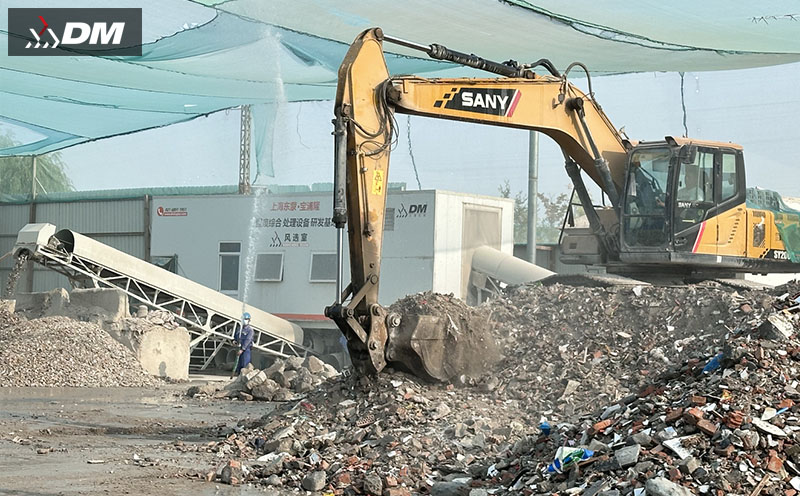
Against the backdrop of accelerating urbanization and in-depth implementation of the "dual carbon" strategy, China generates over 2 billion tons of construction waste annually. The traditional model of "landfilling and stacking" not only occupies a large amount of land resources but also causes ecological problems such as soil pollution and dust diffusion. As the world's largest producer of construction waste, China is addressing the "garbage siege" dilemma through technological innovation—independently developed smart construction waste recycling systems, with the core advantages of "precision sorting, high-value regeneration, green treatment, intelligent management, and flexible deployment," realizing the full-chain resource utilization of construction waste from "landfill to building materials factory." These systems have become core equipment for promoting urban circular economy and building an ecological China, exporting China's "ecological solution" for construction waste treatment to the world.
Core Advantages: Five Ecological Innovations Reshaping the Value Chain of Construction Waste
China's smart construction waste recycling systems are not simple upgrades of traditional recycling equipment, but ecological solutions integrating technologies from multiple fields such as AI, IoT, and environmental engineering. They completely change the status quo of "low utilization and high pollution" of construction waste from five dimensions: sorting efficiency, resource value, environmental standards, operation and maintenance management, and scenario adaptation.
1. AI Precision Sorting: Core Premise for "Full Utilization of Mixed Waste"
Targeting the pain point of construction waste being a mixture of bricks, concrete, steel bars, plastics, and wood, a multi-dimensional intelligent sorting system is created: ① AI vision + multi-physical field collaborative sorting: Integrating an AI material recognition system (99.9% accuracy), electromagnetic sorting, density sorting, and air separation technology, it can automatically separate steel bars (99.8% recovery rate), concrete blocks, masonry aggregates, as well as mixed light materials such as plastics and wood. The sorting efficiency is 80 times higher than manual sorting; ② Dynamic adaptive adjustment: Equipped with material composition sensors, it real-time monitors changes in waste composition and automatically adjusts sorting parameters, maintaining stable sorting accuracy even when facing mixed waste with fluctuating components; ③ Modular sorting combination: Sorting modules can be flexibly configured according to the type of construction waste (demolition waste, renovation waste, road reconstruction waste) to target the separation of different materials. In a demolition project in Xiong'an New Area, the intelligent sorting system processes 1,500 tons of mixed construction waste daily, separating 45 tons of steel bars, 1,200 tons of recycled aggregates, and 30 tons of recyclable plastics, with a comprehensive resource recognition rate of 99.5%.
2. High-Value Regeneration: Leap from "Waste" to "High-End Building Materials"
Subverting the limitations of traditional recycled aggregates with "low strength and narrow applications," transforming construction waste into high-value-added products: ① Recycled aggregate strengthening technology: Recycled aggregates treated with "crushing + shaping + surface activation" have a compressive strength of C80 grade, continuous particle gradation, and can be used in high-speed railway ballastless tracks and super high-rise building concrete, with added value 5 times higher than ordinary recycled aggregates; ② Diversification of derived products: Recycled aggregates can be further processed into recycled permeable bricks, recycled mortar, recycled concrete precast components, etc., adapting to scenarios such as sponge cities, municipal roads, and green buildings; ③ Upgrading of steel bar resource utilization: Waste steel bars separated are processed into building stirrups and embedded parts after derusting and cutting, with a recovery rate of 100% and metal resource loss approaching zero. In the old urban renewal project in Pudong, Shanghai, the intelligent recycling system processes 5 million tons of construction waste annually, producing 4 million tons of C60-grade recycled aggregates and 320 million recycled permeable bricks, supplying urban subway construction and park renovation, saving 230 million yuan in mining costs by replacing natural aggregates.
3. Full-Process Environmental Closed Loop: Zero Pollution Safeguarding the Ecological Environment
Strictly adhering to the country's "strictest environmental standards" (dust ≤5mg/m³, noise ≤65dB(A), zero wastewater discharge), a full-chain environmental protection system is built: ① Fully enclosed dust control: The crushing, sorting, and conveying links adopt fully enclosed corridors + pulse bag filter (dust removal efficiency ≥99.99%) + high-pressure fog cannon, with a dust concentration of ≤2mg/m³ in the operation area, far lower than environmental requirements; ② Ultra-low noise design: The equipment is equipped with a double-layer sound insulation cover and damping vibration reduction base, with an operating noise of ≤60dB(A), enabling operation near residential areas and schools without disturbing the surrounding environment; ③ Zero discharge of recycled wastewater: A closed-loop water circulation system is used for equipment cooling and aggregate cleaning. Wastewater is 100% recycled after "sedimentation + filtration + reverse osmosis" treatment, with a daily water consumption of ≤0.1m³/ton and no wastewater discharge; ④ Residue-free treatment of solid waste: A small amount of inert waste that cannot be utilized after sorting can be processed into subgrade filler, achieving the goal of "zero landfilling." In a recycling base in the Guangdong-Hong Kong-Macao Greater Bay Area, the air quality around the operation area of the intelligent system is better than the urban average, making it a national-level "Green Factory" demonstration project.
4. Intelligent Full-Chain Management: Digital Empowerment for Efficient Operation and Maintenance
Integrating industrial internet technology to realize full-process digital management and control of construction waste recycling: ① IoT real-time monitoring: Equipped with a 5G + IoT system, it real-time collects more than 180 items of data such as processing capacity, sorting accuracy, environmental indicators, and equipment status. Managers can remotely supervise through the cloud platform, with data transmission delay ≤0.3 seconds; ② AI fault early warning: Predicting equipment fault risks based on big data analysis with an accuracy rate of 98%, the equipment's mean time between failures (MTBF) exceeds 25,000 hours; ③ Intelligent production scheduling: The system can dynamically adjust the type and output of recycled products according to the demand of the building materials market and project progress, realizing "on-demand production" and reducing resource waste. In the recycling center of Hangzhou Future Sci-Tech City, one intelligent system can be remotely managed by one operation and maintenance personnel, improving production efficiency by 4 times and reducing operation and maintenance costs by 60%.
5. Flexible Scenario Adaptation: Fixed + Mobile Covering All Scenarios
Targeting the characteristics of construction waste being "large in centralized quantity (demolition projects) and small in scattered quantity (renovation waste)," a diversified deployment plan is provided: ① Large-scale fixed recycling bases: Modular fixed systems (daily processing capacity 5,000 tons) are located in urban suburbs to undertake centralized treatment of bulk construction waste; ② Mobile recycling stations: Tracked/wheeled mobile recycling equipment (daily processing capacity 300-1,000 tons) can directly reach demolition sites and community waste collection points for on-site waste treatment, reducing transportation costs and secondary pollution; ③ Small community recycling points: Mini intelligent sorting equipment is configured to specially handle scattered waste such as renovation waste, realizing "doorstep" recycling. After deploying small recycling points in 10 communities in Chaoyang, Beijing, the sorting and recycling rate of renovation waste increased from 20% to 75%, and transportation costs decreased by 85%.
Technical Core: Four Key Technologies Building the Barrier of Ecological Innovation
The core competitiveness of China's smart construction waste recycling systems stems from four breakthrough technologies, demonstrating independent innovation capabilities:
1. AI Visual Recognition + Multi-Physical Field Sorting Technology: Core Engine for Precision Sorting
Trained with 10 million-level construction waste samples, the AI model can quickly identify waste of different materials and particle sizes. Combined with electromagnetic sorting (separating metals), density sorting (separating aggregates and light materials), and air separation (separating plastics and wood) technologies, it achieves "second-level classification and precision purification" of mixed waste. The sorting accuracy and efficiency reach the international advanced level, laying the foundation for high-value utilization.
2. Recycled Aggregate Strengthening and Derivation Technology: Key to Enhancing Resource Value
Through a full-chain technology of "particle shaping to optimize gradation, surface activation to improve strength, and diversified processing to expand applications," it solves the pain points of low strength and poor durability of traditional recycled aggregates, enabling recycled products to meet the performance standards of raw building materials, expanding application scenarios, and maximizing the resource value of construction waste.
3. Full-Process Environmental Integration Technology: Core Guarantee for Zero Pollution
Building an environmental protection system of "source-sealed dust reduction + process sound insulation and vibration reduction + end wastewater recycling + full utilization of solid waste," achieving ultra-low emissions of pollutants such as dust, noise, and wastewater, and 100% resource utilization of inert waste, completely breaking away from the traditional recycling model of "pollution first, treatment later," and realizing the harmonious coexistence of the treatment process and the ecological environment.
4. 5G + Industrial Internet Intelligent Management Technology: Foundation for Digital Operation and Maintenance
Integrating 5G transmission, edge computing, and AI algorithms to build an intelligent management and control platform, realizing "real-time production data, visualized equipment status, accurate fault early warning, and intelligent scheduling decisions," breaking geographical restrictions, greatly improving operation and maintenance efficiency, reducing labor costs, and providing technical support for large-scale promotion and application.
Typical Application Cases: Empowering Urban Development, Witnessing Ecological Innovation Results
China's smart construction waste recycling systems have been applied in many major national projects, winning wide recognition for their ecological, efficient, and high-value performance:
Case 1: Construction Waste Treatment Project for "Zero-Waste City" in Xiong'an New Area
Project Demand: As a national-level "zero-waste city" pilot, it needs to treat 8 million tons of construction waste generated from new area construction and old village demolition, requiring a resource utilization rate ≥95% and zero environmental pollution. Solution: 4 large-scale intelligent recycling bases (fixed systems) + 20 mobile recycling equipment + smart management and control platform. Application Effects: ① The comprehensive resource utilization rate reaches 98%, producing 6.5 million tons of C70-grade recycled aggregates and 1.5 million cubic meters of recycled precast components, supplying the construction of Xiong'an High-Speed Railway Station and Civil Service Center; ② Dust emission ≤1.5mg/m³, noise ≤58dB(A), zero wastewater discharge, becoming a benchmark for "zero-waste city" construction; ③ Reducing carbon emissions by 300,000 tons annually and saving 1,200 mu of land resources.
Case 2: Construction Waste Recycling Project for Old Urban Renewal in Pudong, Shanghai
Project Pain Points: The old renewal area is scattered with narrow operating spaces, requiring treatment of 3 million tons of construction waste. It is required to be recycled on-site, low-noise and environmentally friendly, and not affect residents' lives. Solution: 15 tracked mobile intelligent recycling equipment + small community sorting points. Application Effects: ① The equipment operates directly at the demolition site, processing 12,000 tons of construction waste daily. Recycled aggregates are supplied to surrounding road reconstruction on-site, reducing transportation costs by 70%; ② Operating noise ≤55dB(A), no complaints from residents during night operation, and dust concentration ≤1.8mg/m³; ③ Producing 280 million recycled permeable bricks annually, supplying the construction of Pudong sponge city, and saving 1.8 million tons of natural stone mining annually.
Case 3: Green Building Materials Regeneration Project in the Guangdong-Hong Kong-Macao Greater Bay Area
Project Demand: Providing high-grade recycled building materials for green buildings in the Greater Bay Area, processing 6 million tons of construction waste annually, requiring recycled aggregate strength ≥C60 and environmental indicators meeting EU standards. Solution: Intelligent modular recycling factory + recycled building materials deep processing production line. Application Effects: ① Annual output of 4.8 million tons of C60-C80 grade recycled aggregates and 3 million cubic meters of recycled concrete, supplying the construction of Guangzhou Nansha Bridge and Shenzhen Qianhai office buildings; ② Environmental indicators are fully superior to EU standards, with dust emission ≤1.2mg/m³ and VOCs emission approaching zero; ③ Driving the development of upstream and downstream industries, creating 1,200 jobs and an annual GDP of over 1.5 billion yuan.
Ecological Going Global: The Global Value of China's Smart Recycling Systems
From domestic "zero-waste city" construction to ecological cooperation with countries along the "Belt and Road," China's smart construction waste recycling systems are becoming a new business card for Chinese ecological equipment "going global" with the core advantages of "ecological friendliness, high efficiency and high value, and advanced technology." They not only solve the garbage problem in China's urbanization process but also convey China's concept of "circular utilization and green development" to the world, providing a replicable and promotable solution for global construction waste treatment.
In the future, China's smart construction waste recycling systems will continue to iterate and upgrade, integrating cutting-edge technologies such as new energy power, digital twins, and blockchain traceability, developing products more suitable for the national conditions of different countries, more intelligent and environmentally friendly, and more cost-effective; deepen international cooperation, build renewable resource treatment bases in countries along the "Belt and Road," share China's technical experience and ecological solutions, help the world achieve the "carbon peak and carbon neutrality" goals, and write a new chapter of China's ecological innovation empowering global sustainable development.
If you would like to get help immediately, you can also fill your requirements on the following form, we will contact you on the right time.


Get In Touch