







1. "Scenario Dilemma" of Nepal's Projects: Poor Equipment Adaptability & Easy Construction Delays
About 75% of Nepal's territory is mountainous or hilly, leading to diverse and complex scenarios for infrastructure and industrial projects: Mountain highways need to handle both "subgrade hard rock aggregates" and "pavement fine aggregates"; rural housing construction requires simultaneous production of "masonry aggregates" and "plastering building sand"; small-scale mining (limestone, gold-associated ore) needs to process "mixed soft and hard ores". However, traditional crushers have "single-scenario limitations" — equipment for aggregate production cannot make sand, and machines for soft rock crushing struggle with hard rocks. This forces projects to purchase multiple devices, resulting in high investment costs (a single traditional crusher costs about 4-6 million Nepalese Rupees) and frequent supply interruptions due to complex equipment switching and maintenance: A mountain highway project once had daily aggregate supply less than 60% of demand due to slow refeeding of traditional equipment, delaying construction by 1.5 months; a rural housing cluster project saw supply disconnection between aggregates and sand (due to separate production equipment), forcing 3 houses to stop construction waiting for materials. For Nepal's projects, "poor scenario adaptability" and "unstable supply" are core causes of construction delays. A crusher with both "high crushing ratio for one-time forming" and "flexible multi-scenario adaptability" is exactly the key to solving this dilemma.
2. High Crushing Ratio & One-Time Forming: Fewer Processes, Fast Output, Core of Avoiding Delays
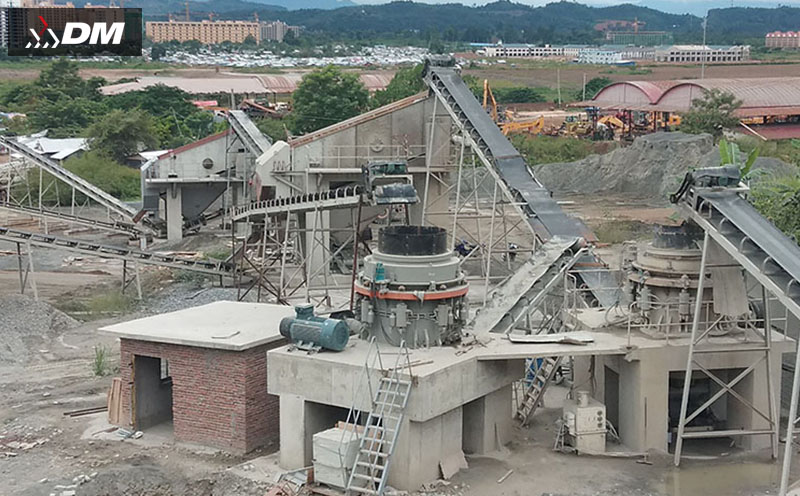
This crusher increases the crushing ratio to 16-22, far exceeding the 5-8 of traditional models, realizing "one-time crushing of large raw stones into qualified finished products". It completely eliminates the inefficient "crushing-refeeding-re-crushing" process, accelerating Nepal's projects from three aspects — "time, energy consumption, and labor" — and preventing construction delays caused by slow production.
1. One-Time Forming Saves Time: Production Cycle Shortened by 60%, Projects "Advance Fast"
Most Nepal's projects face "tight schedules and difficult raw material transportation". Traditional equipment takes over 40 minutes to produce one ton of finished products when processing hard rocks like basalt and granite over 1000mm (needing 2-3 refeedings); relying on its high crushing ratio, this crusher can crush hard rocks into 15-30mm infrastructure aggregates in one go, and soft rocks (limestone) into 0-5mm building sand in one go. The production time per ton is shortened to 15 minutes, halving the production cycle directly. A mountain highway project in Pokhara produced 500 tons of aggregates per day with traditional equipment, requiring overtime to barely meet the "450 tons/day" pavement demand; after switching to this crusher, the daily aggregate output increased to 900 tons. Not only was overtime unnecessary, but aggregate reserves were completed in advance, and the pavement construction period was 20 days ahead of schedule, avoiding construction delays caused by the upcoming rainy season (Nepal's rainy season has heavy rains, easily interrupting mountain road construction).
2. Less Refeeding Saves Energy: Diesel Expenses Reduced by 30%, Projects "Save Costs"
Most Nepal's projects rely on diesel generators for power (diesel price is about 150 Nepalese Rupees/liter). Traditional equipment consumes an additional 15%-20% of diesel for each refeeding; this crusher eliminates the refeeding process, reducing diesel consumption per ton of hard rock crushing from 0.8 liters to 0.5 liters, and per ton of soft rock sand making from 0.6 liters to 0.4 liters, cutting energy costs by 30% directly. A rural housing project near Kathmandu consumed 80 liters of diesel per day for building sand production with traditional equipment; after switching to this crusher, the daily diesel consumption was only 50 liters. Calculated based on 25 working days per month, it saves 112,500 Rupees in monthly diesel costs (150 Rupees/liter × 30 liters/day × 25 days), with a total energy cost savings of 450,000 Rupees during the 4-month project period — equivalent to the monthly salary of 2 local technicians.
3. Simplified Processes Save Labor: 1 Worker Does the Job of 2, Avoiding "Delay Due to Labor Shortage"
The elimination of refeeding reduces labor demand from "3 workers per shift (1 operating the main machine, 2 managing refeeding)" to "2 workers per shift". Even small projects can be handled by 1 worker (responsible for both operation and simple maintenance), solving the "shortage of professional workers and difficulty in recruitment" in Nepal's mountains, and preventing production delays caused by insufficient labor. A small sand-gravel yard in Lumbini needed 4 workers to work in two shifts to supply 3 surrounding rural housing projects, with a monthly labor cost of 160,000 Rupees; after adopting this crusher, 3 workers could complete two-shift production, saving 40,000 Rupees in monthly labor costs and avoiding production interruptions due to inability to recruit workers.
3. Multi-Scenario Adaptability: One Machine Equals Three, "Stable Supply" for All Scenarios
Relying on modular design and easy switching functions, this crusher can flexibly adapt to three core scenarios of Nepal's projects — "mountain highways, rural housing, and small-scale mining". No additional equipment purchase is needed, ensuring stable supply for different needs and avoiding supply interruptions caused by poor equipment adaptability.
1. Mountain Highway Scenario: "One-Click Switch" Between Subgrade/Pavement Aggregates, "No Supply Disconnection"
Mountain highways require "subgrade aggregates (20-30mm) + pavement aggregates (5-15mm)". By adjusting the discharge port size, this crusher can switch quickly without replacing components: enlarge the discharge port to produce 20-30mm coarse aggregates for subgrade construction; reduce the discharge port to produce 5-15mm fine aggregates for pavement construction. The particle shape is round (flakiness content ≤8%), which can be directly used for pavement without additional shaping, avoiding supply disconnection caused by aggregate type switching. A mountain highway project in Mahendranagar previously rented 2 machines to produce subgrade and pavement aggregates separately. Equipment transportation (one-way cost over 20,000 Rupees for mountain transportation) and switching delays once caused a disconnect between subgrade and pavement construction; after switching to this crusher, a single machine completed both tasks, enabling seamless connection between subgrade and pavement construction without any material-waiting shutdowns.
2. Rural Housing Scenario: "Flexible Production" of Aggregates/Sand, "Full Demand Satisfaction"
Rural housing construction requires "masonry aggregates (10-20mm) + plastering sand (0-5mm)". Equipped with a detachable impact sand making module, this crusher can produce aggregates when the module is removed and make sand when the module is installed, with switching completed in 30 minutes. No separate sand making machine is needed, ensuring matching supply rhythms of aggregates and sand, and avoiding "sand-waiting shutdowns" or "aggregate-waiting stoppages". A rural housing cluster project in Chitwan used traditional equipment to produce aggregates and sand in two separate sites, leading to frequent transportation connection issues. Once, plastering sand supply lagged by 10 days after masonry of 2 houses was completed; after switching to this crusher, aggregates and sand could be produced at the same site, with fully matched supply rhythms, and all 10 houses were completed on time.
3. Small-Scale Mining Scenario: "Handles Both Soft & Hard Rocks", "Stable Ore Output"
Small-scale mining in Nepal (e.g., limestone mines, gold-associated ore mines) often faces "difficulty in processing mixed ores". Traditional equipment requires manual sorting of soft and hard rocks, leading to low efficiency and easy supply interruptions; equipped with a PLC intelligent control system, this crusher can real-time identify ore hardness and automatically adjust crushing pressure. It can stably crush mixed soft and hard ores without sorting, with daily processing capacity 50% higher than traditional equipment. A small gold mine in Manang District processed mixed ore of associated granite (hard rock) and limestone (soft rock) with traditional equipment, achieving only 200 tons of daily processing capacity and frequent supply interruptions due to slow sorting; after switching to this crusher, the daily processing capacity increased to 300 tons. The crushed ore had uniform particle size, facilitating subsequent mineral processing without any beneficiation shutdowns caused by insufficient ore supply.
4. Stable Supply Guarantee: Durable & Easy to Maintain, Avoiding Supply Interruptions & Delays
Nepal's projects have weak risk resistance, and equipment failure-induced supply interruptions will directly delay construction. This crusher ensures long-term stable supply from "durability" and "maintenance convenience" to avoid delaying project schedules.
- Composite Wear-Resistant Parts: Doubled Service Life, Fewer Failures: Core wear-resistant parts (jaw plates, lining plates) are made of "high-manganese steel + tungsten carbide" composite material with a hardness of HRC68, whose service life is 2.5 times longer than traditional parts. When processing hard rocks, the service life of jaw plates is extended from 300 hours to 750 hours, reducing monthly maintenance times from 3 to 1, and avoiding supply interruptions caused by frequent part replacements;
- Easy-Maintenance Design: Repairable in Mountains, No Work Stoppages: Vulnerable parts adopt "snap-on installation", which can be replaced by mountain workers after 1 hour of training without professional tools. This avoids long-term shutdowns caused by "waiting for professional technicians to repair" (traditional equipment requires 2-3 days for technicians to arrive after failures, easily delaying construction).
5. Conclusion: Adapting to Multiple Scenarios, Helping Nepal's Projects "Build Fast, Economically & Stably"
The development of Nepal's projects requires equipment that can adapt to complex scenarios and ensure stable supply. With "one-time forming" to solve slow production-induced delays, "multi-scenario adaptability" to ensure stable supply for different needs, and reduced energy and labor costs, this high-crushing-ratio crusher perfectly fits Nepal's projects with "tight schedules, complex scenarios, and limited budgets". In the future, as more Nepal's projects adopt this equipment, it will surely promote the rapid completion of mountain highways, batch construction of rural housing, and efficient development of small-scale mining, injecting strong momentum of "no delays and stable reliability" into Nepal's infrastructure and industrial upgrading.
If you would like to get help immediately, you can also fill your requirements on the following form, we will contact you on the right time.


Get In Touch