







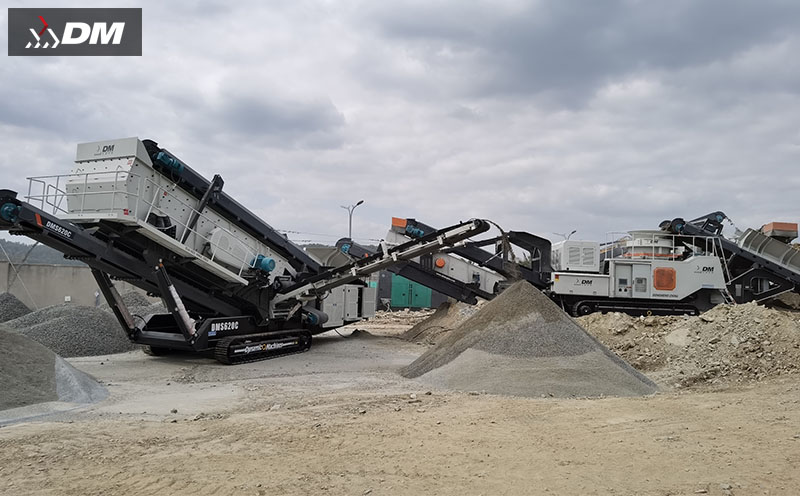
Nepal, located at the southern foot of the Himalayas, boasts enormous potential in mineral resources (limestone, granite, marble, etc.) and hydropower infrastructure projects. The mining and construction industries are experiencing a period of rapid development. However, local enterprises have long faced the dilemma of "high investment and low returns": imported high-end equipment is expensive, causing significant financial pressure; outdated equipment is inefficient and energy-intensive, leading to high operating costs; complex mountainous terrain and unstable power supply further exacerbate production challenges. The cost-effective crushing equipment tailored for the Nepalese market, with core advantages of "low investment, high performance output, and strong environmental adaptability," maximizes production capacity and revenue while controlling procurement and operating costs, making it an ideal choice for mines and construction sites in Nepal to achieve "low input and high returns."
I. Profit Pain Points of Nepal's Mines and Construction Sites: Dual Constraints of High Costs and Low Efficiency
Operating scenarios in Nepal have distinct characteristics: dominated by mountainous terrain, inconvenient transportation, volatile power supply, and rising labor costs. Traditional equipment and operating models are difficult to adapt, resulting in severely compressed profit margins for enterprises.
Pain Point 1: High Equipment Procurement Costs, Heavy Financial Pressure. Imported brand crushing equipment is expensive, with a single unit procurement cost 50%-80% higher than ordinary equipment, which is unaffordable for small and medium-sized enterprises. To save initial investment, some enterprises choose second-hand or low-quality equipment, but suffer from frequent failures and high maintenance costs, falling into a vicious cycle of "low-cost purchase and high-cost maintenance" and facing difficulties in capital turnover.
Pain Point 2: Poor Power Adaptability, High Operating Costs. Remote mountainous areas in Nepal have low power grid coverage and unstable power supply, leading to frequent shutdowns of pure electric-driven equipment due to power outages. Traditional diesel equipment has high fuel consumption (over 30L per hour), and diesel relies on imports with volatile prices, with fuel costs accounting for more than 40% of operating costs. Some equipment lacks energy-saving designs, with a unit material processing energy consumption of 14-18kWh/t, further pushing up operating costs.
Pain Point 3: Insufficient Terrain Adaptability, Restricted Capacity Release. Most of Nepal's mines and construction sites are located in mountainous areas, with narrow venues and rough roads. Large fixed crushing plants are difficult to transport and install, with high transfer costs. Ordinary mobile equipment has poor stability and insufficient climbing capacity, making it impossible to operate on slopes steeper than 30°. The unreasonable design of the equipment's feed inlet makes it prone to material jamming when facing large ore (particle size over 600mm), and the actual capacity is only 60%-70% of the designed value.
Pain Point 4: High Maintenance Costs, Severe Downtime Losses. Wearing parts of second-hand or low-quality equipment are made of poor materials, with liners and hammers having a service life of only 80-120 hours, requiring frequent replacement. Key spare parts rely on imports with a transportation cycle of 1-2 months, and the capacity loss during downtime waiting for parts can reach tens of thousands of US dollars. The equipment has a complex structure, and maintenance requires professional technicians, but local technical talents in Nepal are scarce, leading to increased maintenance costs and time costs.
II. Cost-Effective Crushing Equipment: Four Core Advantages for Low Input and High Returns
Targeting the operating pain points in Nepal, the cost-effective crushing equipment focuses on "cost control + performance optimization." While ensuring equipment reliability and efficiency, it significantly reduces procurement, operating, and maintenance costs. With a processing capacity ranging from 50-300t/h and a maximum feed size of ≤650mm, it is suitable for crushing limestone, granite, construction waste, and other materials, perfectly matching the operating needs of small and medium-sized enterprises in Nepal.
(I) Cost-Effective Pricing, Reducing Financial Pressure
The equipment adopts a production model of "localized supply chain + imported core components." On the premise of ensuring key technologies and quality, it greatly reduces production costs. The procurement price of a single unit is 30%-50% lower than that of imported brands, and flexible payment plans (such as installment payment and leasing) are provided to reduce the initial financial pressure on enterprises.
The equipment undergoes rigorous quality inspections, with a warranty period of up to 18 months for core components (engine, motor, hydraulic system), 6 months longer than the industry standard, reducing later maintenance investment. At the same time, the equipment has a low failure rate (annual failure rate ≤5%), avoiding capital waste and capacity loss caused by frequent maintenance, allowing enterprises to "spend less money and buy reliable equipment."
(II) Multi-Power + Energy-Saving Design, 35% Direct Reduction in Operating Costs
The equipment is equipped with a three-mode power system of "diesel + electric + diesel-electric hybrid," perfectly adapting to Nepal's power supply situation. When the power grid is stable, it switches to the electric mode, adopting an energy-saving motor (power 75-250kw) with a unit material processing energy consumption as low as 8-11kWh/t, 30% more energy-efficient than traditional equipment. When there is no power grid or the power supply is unstable, it switches to the diesel mode, equipped with a low-fuel-consumption engine (fuel consumption only 16-22L per hour), saving more than 30% in fuel costs compared to traditional equipment. The diesel-electric hybrid mode can automatically switch according to the power supply, ensuring continuous operation of the equipment, with an effective operating time of over 95%.
For example, after a granite mine in Nepal adopted this equipment, the monthly fuel cost decreased from 45,000 US dollars to 28,000 US dollars, and the electricity cost was saved by 8,000 US dollars, with a direct 37% reduction in monthly operating costs.
(III) Mountain-Adapted Design, 50%+ Capacity Improvement
The equipment has been specially optimized for mountainous terrain: it adopts a lightweight tracked chassis with low ground pressure and a climbing capacity of 35°, which can easily cope with rugged mountainous areas and steep slopes in Nepal. The chassis height is adjustable to adapt to the flatness requirements of different venues. It can be transferred without disassembly and deployed within 1 hour, reducing transfer costs by 80%. The feed inlet design is optimized (maximum feed size ≤650mm), combined with a "deep-cavity crushing structure," which has strong material gripping capacity and avoids material jamming. The actual capacity utilization rate is over 90%. The processing capacity ranges from 50-300t/h, which can be flexibly selected according to the enterprise scale. The daily processing capacity of small and medium-sized mines has increased from 400 tons to 600-800 tons, with a significant release of production capacity.
(IV) Easy Maintenance + Localized Support, Reducing Comprehensive Costs
Wearing parts are made of high-chromium alloy materials, treated with special heat treatment processes, extending the service life of liners and hammers to 300-400 hours—2-3 times longer than traditional equipment—greatly reducing replacement frequency. Key spare parts are supplied locally, with a spare parts warehouse established in Kathmandu. Core spare parts are delivered within 72 hours, and to remote areas within 5 working days, completely solving the problem of "downtime waiting for parts." The equipment adopts a modular design, and wearing parts can be replaced without professional tools. Ordinary workers can complete the replacement after simple training, with the replacement time shortened to less than 1 hour, reducing labor costs.
At the same time, free installation and commissioning, operation training, and regular maintenance services are provided to help enterprises quickly master equipment usage skills, reduce operational errors and failure rates, and extend equipment service life.
III. Field Cases: High Return Testimonials from Nepalese Enterprises
The cost-effective crushing equipment has been widely applied in multiple mines and construction sites in Nepal. With its core advantages of "low input, high output, and low cost," it has helped enterprises double their profits.
Case 1: A limestone mine in central Nepal. Previously using second-hand imported equipment with a procurement cost of 300,000 US dollars, the monthly average operating cost (fuel + spare parts + labor) was 42,000 US dollars, the daily processing capacity was 400 tons, and the monthly net profit was only 50,000 US dollars. After replacing with cost-effective crushing equipment, the procurement cost dropped to 210,000 US dollars, the monthly average operating cost decreased to 26,000 US dollars, the daily processing capacity increased to 700 tons, and the monthly net profit reached 120,000 US dollars, with an investment payback period of only 6 months.
Case 2: A construction site near Kathmandu. Previously using ordinary mobile crushing equipment, due to insufficient climbing capacity and high fuel consumption, the monthly average downtime was 3-4 days, the fuel cost was 30,000 US dollars, the monthly processing capacity of construction waste was 8,000 tons, and the net profit was 60,000 US dollars. After adopting cost-effective equipment, the climbing capacity and stability were significantly improved, the monthly downtime was reduced to less than 1 day, the fuel cost dropped to 18,000 US dollars, the monthly processing capacity increased to 12,000 tons, and the monthly net profit reached 150,000 US dollars, a 150% profit increase.
IV. Conclusion: Choose Affordable Power to Unlock New Profit Potential in Nepal's Market
Against the backdrop of the rapid development of Nepal's mining and infrastructure industries, the key to enterprise profitability lies in "controlling costs and improving efficiency." The cost-effective crushing equipment breaks the traditional perception that "high price = high performance." With its core advantages of "affordable pricing, high efficiency, strong adaptability, and low maintenance costs," it perfectly adapts to the operating scenarios and enterprise needs in Nepal. It allows small and medium-sized enterprises to enjoy the capacity improvement and cost savings brought by high-performance equipment without bearing high investment.
In the future, this series of equipment will further deepen localized layout, optimize the structural design adapted to Nepal's mountainous terrain, expand the local spare parts supply network, and provide more flexible leasing and after-sales service plans to help more Nepalese enterprises reduce input and increase returns. Choosing cost-effective crushing equipment means choosing "low cost, high efficiency, and stable profitability," allowing you to easily seize market opportunities in Nepal's mountainous operations and achieve long-term profitability and sustainable development.
If you would like to get help immediately, you can also fill your requirements on the following form, we will contact you on the right time.


Get In Touch