







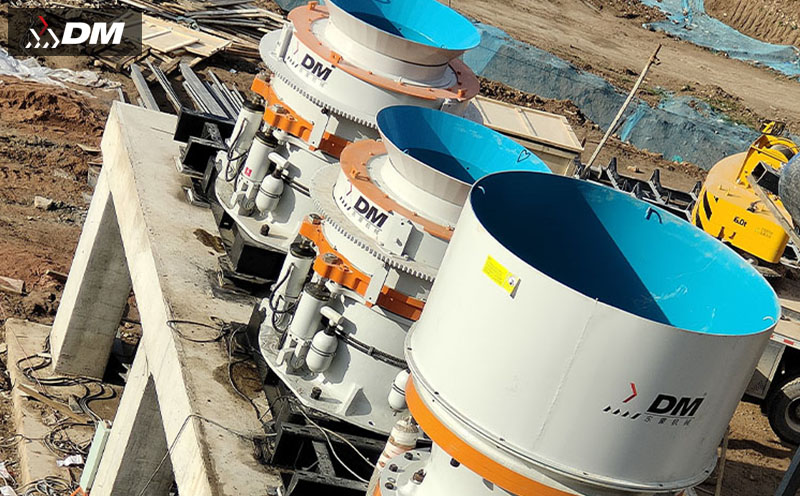
"Namaste" — With respect for Nepal and adaptability considerations, the tough crusher specially built for this land makes its debut! Nepal is blessed with the complex terrain at the southern foot of the Himalayas, where mineral resource mining is mostly concentrated in high-altitude mountainous areas. Meanwhile, urban infrastructure expansion is in full swing in cities like Kathmandu and Pokhara. Both scenarios put forward core requirements for crushing equipment: "extreme toughness, strong environmental resistance, and multi-scenario adaptability." Traditional equipment either struggles to withstand the harsh conditions of high altitude, large temperature differences, and high-hardness ores in mountainous areas, or fails to meet the demands for efficiency, environmental protection, and flexible transfer in urban construction. This tough crusher tailored for Nepal, centered on "durability, full-domain adaptability, and high efficiency and stability," can not only operate continuously under harsh working conditions in the Himalayan foothills but also provide high-quality aggregates for urban construction, becoming a core equipment connecting mountain mining and urban development.
I. Core Challenges of Nepal's Dual Operating Scenarios: Dual Tests of Toughness and Adaptability
Nepal's crushing operation scenarios present dual characteristics of "mountainous areas + cities." The working conditions of the two are quite different, but the demand for equipment toughness is highly consistent, which traditional equipment can hardly meet.
Challenge 1: High Altitude + Large Temperature Difference in Mountainous Areas, Insufficient Equipment Durability. Mines in the Himalayan foothills are mostly located at altitudes of 1500-4000 meters, with thin air and low air pressure. Traditional engines suffer from severe power attenuation (attenuation rate of 15%-20%); the daily temperature difference can reach more than 20℃ (nighttime -5℃-0℃, daytime 25℃-30℃), making metal parts of equipment prone to cracking and seal failure due to thermal expansion and contraction; ores are mostly high-hardness granite and basalt (hardness 200-300MPa), traditional crushing cavities are easy to wear, hammers are easy to break, and the equipment failure rate is as high as 15% or more.
Challenge 2: Rugged Terrain in Mountainous Areas, Restricted Equipment Stability and Mobility. Mountain mine roads are narrow and steep (some sections have slopes exceeding 35°), ordinary mobile equipment has poor chassis support and is prone to rollover; the site flatness is poor, fixed equipment is difficult to install, and transfer requires disassembly and transportation, which is time-consuming and labor-intensive; some mining areas are muddy during the rainy season, and equipment is easy to get stuck, leading to operation interruption.
Challenge 3: High Efficiency and Environmental Protection Requirements of Urban Construction, Traditional Equipment Hard to Meet Standards. Urban infrastructure projects (roads, bridges, residences) have high requirements for aggregate quality (uniform particle size, low needle-like content), traditional equipment has low crushing efficiency, and the qualified rate of finished materials is less than 80%; urban operation sites are limited, equipment needs flexible transfer, and large fixed crushing stations have poor adaptability; at the same time, cities have strict control over noise and dust pollution, traditional equipment has noise exceeding 85 decibels, dust emissions do not meet standards, and are prone to being ordered to stop work.
Challenge 4: Multi-Material Crushing Demand, Insufficient Equipment Compatibility. Mountain minerals in Nepal include various high-hardness materials such as granite, limestone, and quartzite. Urban construction needs to process recycled materials such as construction waste and concrete blocks. Traditional equipment is mostly designed for single-material adaptation. When switching crushing types, it is necessary to greatly adjust parameters or even replace components, resulting in low efficiency and high cost, which is difficult to meet the "one-site multi-material" operation demand.
II. Core Advantages of the Tough Crusher: Three Guarantees to Adapt to Nepal's Dual Scenarios
Targeting the dual operating challenges in Nepal, the crusher focuses on three dimensions: "structural reinforcement, environmental adaptation, and function optimization," creating a tough equipment that "can withstand mountainous areas and perform well in cities." With a processing capacity ranging from 80-400t/h and a maximum feed size of ≤800mm, it perfectly adapts to high-hardness ore mining in mountainous areas and high-quality aggregate production in urban construction.
(I) Extreme Toughness Design, Withstanding Harsh Working Conditions and High-Hardness Materials
The equipment adopts a dual guarantee of "reinforced structure + wear-resistant materials" to create a durable body: the frame is welded with 16mm thick high-strength manganese steel, and undergoes overall heat treatment process, increasing deformation resistance by 50%, which can withstand collisions and vibrations in mountain operations; the crushing cavity uses "thickened high-chromium alloy liners" (thickness up to 120mm), and the hammers are made of imported high-chromium alloy + tungsten steel composite materials, treated with high-temperature quenching, with a hardness of over HRC60. Facing high-hardness ores of 200-300MPa, the service life is extended to 400-600 hours, 3 times longer than traditional equipment.
For high-altitude environments, the engine and hydraulic system are optimized: a high-altitude adaptive engine is adopted, which compensates for insufficient air pressure through intake supercharging technology, and the power attenuation rate is controlled within 5%; the hydraulic system uses low-temperature resistant hydraulic oil and reinforced seals, which can operate stably in a temperature difference environment of -5℃-35℃, reducing the failure rate of seal failure by 90%; the electrical system is equipped with moisture-proof and corrosion-proof protection to adapt to the humid and dusty environment in mountainous areas.
(II) Full-Domain Adaptability Design, Balancing Mountain Mobility and Urban Flexibility
Mountain adaptation optimization: equipped with a "heavy-duty tracked chassis," using widened and thickened tracks (width 600mm), with a ground pressure as low as 0.08MPa and a climbing capacity of 40°, which can easily cope with steep mountain roads and muddy sites; the chassis is equipped with a four-point hydraulic support system, which can quickly level on uneven ground, increasing equipment stability by 80% and avoiding rollover risks; transfer does not require disassembly, and the tracked design can drive directly, increasing transfer efficiency by 3 times under complex road conditions.
Urban scenario adaptation: adopts a "modular + compact" design, with optimized equipment size, which can be flexibly deployed in narrow urban sites; equipped with a "low-noise crushing cavity" and "spray dust removal system," the operation noise is controlled within 75 decibels, and the dust emission concentration is ≤10mg/m³, meeting Nepal's urban environmental protection standards; during transfer, it can be transported by ordinary trucks without special vehicles, reducing urban transfer costs and meeting the needs of continuous operation in multiple construction sites.
(III) High-Efficiency and Multi-Functional Design, Balancing Capacity and Material Compatibility
High-efficiency crushing to increase capacity: adopts a "high-energy crushing system," optimizes the crushing cavity structure (deep cavity + involute design), making material feeding smoother, crushing efficiency increased by 30%, and processing capacity increased by 40%-60% compared with traditional equipment; combined with a "multi-stage screening system," the finished material has uniform particle size, with needle-like content ≤7% and a qualified rate of over 95%, which can be directly supplied to high-end urban infrastructure projects, increasing the aggregate premium capacity by 12%-15%.
Multi-material compatible switching: built-in "multi-material crushing modes" (ore crushing, construction waste recycling, fine crushing for sand making), one-click switching of parameters through the intelligent control system, no need to replace core components,即可 adapt to different materials such as granite, limestone, and concrete blocks; for construction waste recycling, equipped with a "steel bar separation device," which automatically separates steel bars from waste, improving the purity of recycled aggregates and expanding the equipment application scenarios.
III. Field Applications: Dual Verification in Mountainous and Urban Areas
The tough crusher has been put into use in multiple mountainous mines and urban infrastructure projects in Nepal, winning high recognition from users with its advantages of "durability and full-domain adaptability."
Case 1: A high-altitude granite mine in the Himalayan foothills (altitude 2800 meters). Previously using traditional equipment, due to high-altitude power attenuation and frequent failures caused by temperature differences, the average monthly downtime was 8-10 days, and the daily processing capacity was only 300 tons. After replacing with the tough crusher, the equipment power is stable, the temperature difference adaptability is strong, the average monthly downtime is reduced to 1-2 days, the daily processing capacity is increased to 550 tons, the qualified rate of finished materials is increased from 75% to 96%, and the monthly net profit is increased by 180,000 US dollars.
Case 2: Kathmandu Urban Ring Road Expansion Project. Previously using ordinary crushing equipment, it was complained about due to excessive noise, ordered to rectify due to dust pollution, and the inconvenient transfer affected the construction progress. After adopting the tough crusher, both noise and dust emissions meet the standards, no need to worry about environmental penalties; the equipment can be flexibly transferred and quickly deployed in multiple construction sections, processing 800 tons of construction waste and ore per day, 50% higher than the original equipment, the project construction period is shortened by 3 months, and the cost is saved by 250,000 US dollars.
IV. Conclusion: Salute Nepal with Toughness, Assist the Coordinated Development of Dual Scenarios
Nepal's development is inseparable from the support of mountain mineral resources and the upgrading of urban infrastructure. This tough crusher specially built for Nepal, with the respect of "Namaste," deeply adapts to the harsh working conditions of the Himalayan foothills and the efficient needs of urban construction. It breaks environmental constraints with extreme toughness, connects mountains and cities with full-domain adaptability, and ensures production continuity with high efficiency and stability.
In the future, this series of equipment will further deepen localized optimization, improve the adaptability of the equipment in extremely high-altitude areas based on the actual feedback of Nepalese users, add local language operation interfaces, expand the local spare parts supply network, and provide users with more intimate services. Choosing this tough crusher means choosing "durability and reliability, full-domain versatility, and high-efficiency profitability." Let it be your reliable partner in mountain mining and urban construction in Nepal, and witness the development and prosperity of this land together.
If you would like to get help immediately, you can also fill your requirements on the following form, we will contact you on the right time.


Get In Touch