







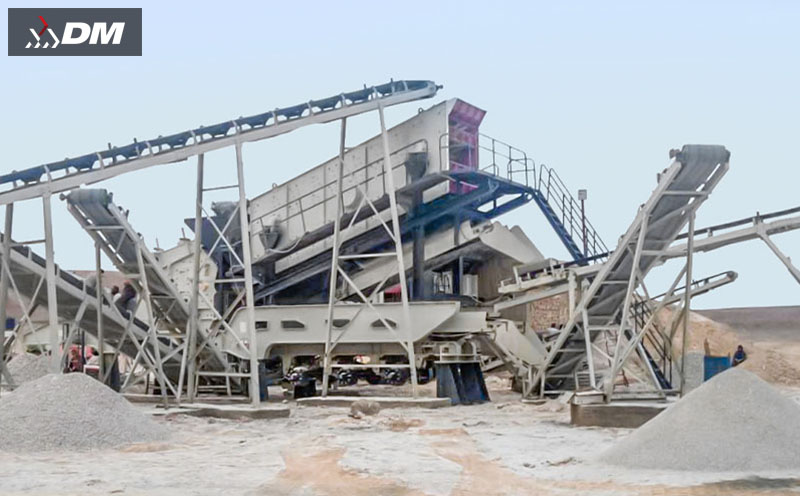
In Nepal, whether it's scattered operations in mountainous mining areas or intensive construction in urban infrastructure, "limited space, easy operation, and timely local services" have become core demands for equipment selection. Traditional crushers are either too large to deploy in narrow spaces, too complex to operate relying on professional technicians, or lack localized support leading to delayed fault repairs and spare parts supply. The "compact and efficient crusher" tailored for the Nepalese market, with core advantages of "small size, simple operation, and strong local support," not only adapts to the space needs of narrow mountain mining areas and crowded urban construction sites but also lowers the operation threshold. Combined with full-process localized services, it makes production more worry-free and profitability easier, becoming the preferred equipment for small and medium-sized enterprises in Nepal.
I. Core Pain Points of Operating Scenarios in Nepal: Triple Constraints of Space, Operation, and Services
Operating scenarios in Nepal generally face problems of "limited space, uneven skill levels of operators, and insufficient local service resources." The design concept of traditional equipment is seriously disconnected from actual needs, resulting in low production efficiency and high operating costs.
Pain Point 1: Limited Space, Difficult Equipment Deployment. Most mountainous mining areas are small operating surfaces opened up on steep slopes, with a width of only 5-8 meters, making it impossible for large crushing equipment to enter; urban construction sites are often located in residential areas or narrow streets, with construction space limited by buildings and pipelines. Fixed crushing stations are cumbersome to install, and even mobile equipment is too large to turn around flexibly, leading to equipment utilization rate of less than 50%.
Pain Point 2: Complex Operation, Dependence on Professional Talents. Parameter adjustment of traditional crushers involves multiple links such as feeding speed, crushing gap, and screening precision. The control panel is full of buttons, requiring professional knowledge for accurate operation. Local operators in Nepal have uneven skill levels and lack systematic training, which is prone to parameter setting errors, leading to unqualified finished materials, equipment jamming, and other problems that directly affect production progress.
Pain Point 3: Delayed Services, Difficulties in Maintenance and Spare Parts. Most imported equipment suppliers have not established local service networks in Nepal. After a fault occurs, it is necessary to wait for overseas engineers to visit, with a response cycle of 7-15 days. Spare parts rely on imports, with a transportation and customs clearance cycle of 1-2 months. "Downtime waiting for parts" has become the norm, and the monthly production capacity loss caused by delayed services can reach tens of thousands of US dollars. Local maintenance personnel lack training related to the equipment, and even simple faults take a long time to solve.
Pain Point 4: Mismatched Efficiency, High Energy Consumption. Although traditional small crushers are relatively small in size, their crushing efficiency is low, with a processing capacity of only 30-50t/h, which is difficult to meet the production capacity needs of small and medium-sized enterprises. Large equipment has excessively high energy consumption, with a unit material processing energy consumption of 15-20kWh/t. Against the background of tight power supply and high electricity prices in Nepal, operating costs remain high.
II. Compact & Efficient Crushers: Three Core Advantages to Solve Nepal's Operating Problems
Targeting the operating pain points in Nepal, the crusher takes "space adaptation, simplified operation, efficiency improvement, and local empowerment" as the core design concepts, creating "small but powerful, simple but refined" equipment. With a processing capacity ranging from 40-250t/h and a maximum feed size of ≤600mm, it is suitable for crushing limestone, granite, construction waste, and other materials, perfectly matching the operating needs of small and medium-sized mines and urban construction sites in Nepal.
(I) Compact Design, Adapting to Flexible Deployment in Narrow Spaces
The equipment adopts "modular integration + lightweight design" to greatly optimize the body size: the overall width is only 2.8 meters and the height is 3.5 meters, 30% smaller than traditional equipment with the same production capacity, which can easily enter narrow mountain operating surfaces and crowded urban construction sites. The weight is controlled at 18-25 tons, no large hoisting equipment is needed, and ordinary forklifts can complete loading, unloading, and deployment. Installation and commissioning only take 2-3 hours, saving 80% of deployment time compared with traditional equipment.
Flexible movement solutions are designed for different scenarios in mountainous and urban areas: equipped with a small tracked chassis with low ground pressure, it can drive smoothly on uneven ground with a climbing capacity of 30°, and transfer in mountainous areas does not require disassembly. In urban scenarios, it can quickly switch to wheeled mobile mode, transported through ordinary roads, reducing transfer costs by 70%. The equipment supports multi-angle feeding and discharging adjustment, and can flexibly adjust the installation position according to the site space, adapting to the space constraints of different operating environments.
(II) Ultra-Simple Operation, Easy for Ordinary Workers to Master
Create a "foolproof" operation experience to lower the technical threshold: equipped with a 10-inch color touch screen supporting bilingual display in Nepali and English, the interface design is concise and intuitive, with only three key buttons for core operations: "Start, Stop, Mode Selection." It has built-in 8 preset operating modes (such as mountain ore crushing, urban construction waste recycling, fine crushing for sand making, etc.). Without professional knowledge, operators only need to select the corresponding mode according to the material type, and the equipment will automatically match the optimal operating parameters to achieve "one-click start and automatic operation."
Optimize intelligent auxiliary functions to reduce manual intervention: equipped with a material induction system to automatically adjust the feeding speed and avoid material jamming; with automatic detection function for finished material particle size, it can feedback screening precision in real time. If adjustment is needed, parameters can be modified with one click through the touch screen without manual disassembly and adjustment. The equipment operating status (rotational speed, temperature, output) is displayed in real time visually. When a fault occurs, it will automatically pop up fault prompts and solutions in Chinese/Nepali. Ordinary workers can operate independently and conduct basic troubleshooting after 1 hour of training.
(III) High Efficiency & Low Consumption + Strong Local Support, Worry-Free Production and Stable Profitability
Small body contains strong power, balancing efficiency and energy saving: adopting a high-efficiency motor and optimized crushing cavity structure, the crushing efficiency is increased by 25%, and the processing capacity is 40% higher than that of traditional equipment of the same size. The processing capacity of 40-250t/h can meet the needs of enterprises of different sizes. The unit material processing energy consumption is as low as 7-10kWh/t, 30% more energy-saving than traditional equipment, effectively reducing electricity costs. Equipped with a low-fuel-consumption diesel backup power supply, it can switch seamlessly when the power supply is unstable, ensuring continuous operation of the equipment with an effective operating time of 95%.
Full-process localized support to solve service pain points: 3 local service centers have been established in Kathmandu, Pokhara, and Biratnagar, forming a team of 15 professional engineers. All engineers have received systematic training from the original factory and are familiar with the equipment structure and local operating scenarios. A "24-hour service hotline + 48-hour on-site maintenance" mechanism has been established. Common faults are solved immediately through remote guidance, and engineers arrive at the scene within 48 hours for complex faults. A 1,000㎡ spare parts warehouse has been built in Kathmandu, storing core spare parts and wearing parts, which can be delivered nationwide within 72 hours and to remote areas within 5 working days. Free on-site training and regular return visits are provided to help users proficiently master operation and maintenance skills and extend equipment service life.
III. Field Cases: Worry-Free Profitability Testimonials from Nepalese Users
The compact and efficient crusher has been widely applied in multiple small and medium-sized mines and urban construction sites in Nepal. With its advantages of "space adaptation, simple operation, and timely services," it has won wide praise from users.
Case 1: A mountain limestone mine in central Nepal (operating surface width 6 meters). Previously using traditional small crushers, which were too large to enter the core operating area, ore had to be transported manually, with a monthly output of only 8,000 tons and high operating costs. After replacing with this equipment, the small body can be directly deployed in the operating area without manual transportation, and the monthly output increased to 15,000 tons. Ordinary workers can operate it after simple training, saving the cost of recruiting professional technicians. The local service team conducts regular return visits, and the equipment failure rate is reduced to less than 3%, with a monthly net profit increase of 60,000 US dollars.
Case 2: An urban road renovation project in Kathmandu (construction site located in a narrow street). Previously using large crushing equipment, which was difficult to transfer and time-consuming to deploy, and required special personnel on duty due to complex operation, with an average monthly downtime of 2-3 days. After adopting the compact and efficient crusher, the equipment can be flexibly deployed, and transfer only takes 1 hour. Ordinary construction workers can operate it without additional technical personnel. When maintenance is needed due to faults, local engineers arrive at the scene to handle it within 24 hours, and the average monthly downtime is reduced to 0.5 days. The monthly processing capacity of construction waste increased from 6,000 tons to 10,000 tons, the project was completed 2 months ahead of schedule, and the cost was saved by 120,000 US dollars.
IV. Conclusion: Compact & Efficient + Local Support, Unlocking a New Production Experience in Nepal
In Nepal, the core competitiveness of production lies not only in equipment performance but also in "whether it adapts to the scenario, whether it is easy to operate, and whether timely support can be obtained." The compact and efficient crusher breaks the traditional perception that "only large equipment has efficiency" and "high performance means complex operation." With a compact body, it adapts to narrow spaces; with ultra-simple operation, it lowers the technical threshold; with localized services, it solves after-sales problems. It allows small and medium-sized enterprises to enjoy profit growth brought by efficient production without bearing high investment and complex management.
In the future, this series of equipment will further deepen localized optimization, add more preset modes suitable for Nepalese operating scenarios, expand local spare parts reserves and service network coverage, and provide flexible cooperation schemes such as equipment leasing and trade-in. It will help more Nepalese enterprises reduce operating costs and improve production efficiency. Choosing a compact and efficient crusher means choosing "space-saving, labor-saving, cost-saving, and stable profitability," making it your worry-free partner in mountain mining and urban construction in Nepal, and jointly contributing to the development of local industries.
If you would like to get help immediately, you can also fill your requirements on the following form, we will contact you on the right time.


Get In Touch