







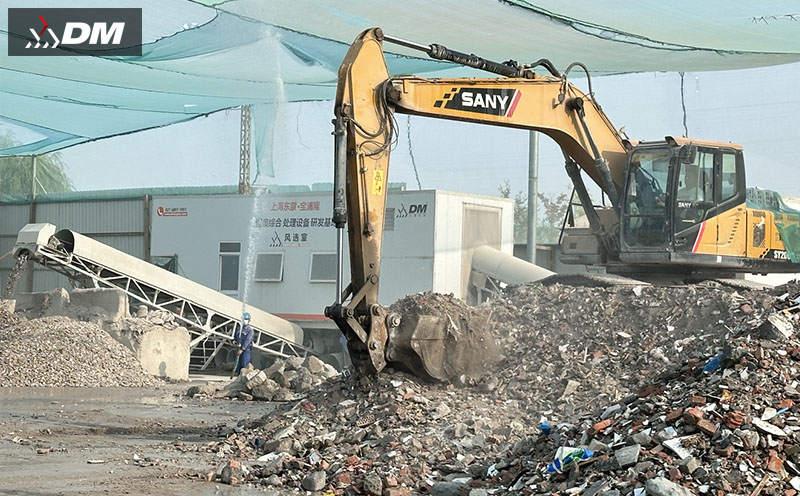
As Nepal accelerates the construction of "smart cities" in Kathmandu, Pokhara, Lalitpur, and other urban centers, population agglomeration and urban expansion have brought severe waste challenges—over 5 million tons of construction waste, 2 million tons of municipal solid waste are generated annually, with electronic waste growing at 12% per year. The traditional model of "landfill-dominated, extensive treatment" has led to urban land scarcity, water pollution, and declining air quality, conflicting with the core concepts of "green, circular, and efficient" smart cities. Based on Nepal's urban development needs, DongMeng has integrated core technologies such as intelligent sorting, high-value recycling, and environmental protection treatment to create a trinity waste management solution of "fixed plants + mobile stations + smart management." Centered on "precision intelligent classification, high-value resource utilization, closed-loop environmental treatment, and digital operation and maintenance," it has become a core partner for Nepal in building green smart cities, transforming urban waste into valuable resources for sustainable development.
Core Advantages: Five Smart Highlights Solving Urban Waste Challenges
DongMeng's urban waste solution is not a mere stack of equipment, but an intelligent systematic solution tailored to the characteristics of Nepal's urban waste (high mixing degree, insufficient classification, and urgent demand for resource utilization). It provides full-cycle waste treatment support for smart cities from five dimensions: classification efficiency, utilization value, environmental standards, deployment flexibility, and operational convenience.
1. Intelligent Precision Sorting: First Step to "Turn Waste into Treasure"
Targeting the mixed nature of Nepal's urban waste (combining bricks, concrete, metal, plastic, and wood), a multi-dimensional intelligent sorting system is created: ① AI vision + multi-physical field sorting: Integrating AI material recognition (99.8% accuracy), electromagnetic sorting, density sorting, and air separation technology, it can automatically separate steel bars (99.5% recovery rate), concrete blocks, and bricks from construction waste; recyclable plastics (99% purity), metals, and organic waste from municipal solid waste. The sorting efficiency is 50 times higher than manual sorting; ② Modular sorting design: Sorting modules can be flexibly combined according to urban waste composition—focusing on "crushing + metal sorting + aggregate purification" for construction waste, strengthening "organic/inorganic separation + recyclables purification" for municipal solid waste, and configuring "precision dismantling + precious metal sorting" for electronic waste; ③ Dynamic adaptive adjustment: Equipped with material composition sensors, it real-time monitors changes in waste composition and automatically adjusts sorting parameters to ensure stable sorting accuracy. In Kathmandu's urban demolition project, DongMeng's intelligent sorting system processes 1200 tons of mixed construction waste daily, separating 35 tons of steel bars, 980 tons of recycled aggregates, and 20 tons of recyclable plastics, with a comprehensive resource recovery rate of 95%.
2. High-Value Resource Utilization: From "Urban Waste" to "Urban Resources"
Subverting the dilemma of traditional recycling's "low-end products and low added value," transforming waste into high-value urban building materials: ① High-value recycling of construction waste: Recycled aggregates treated with "crushing + shaping + strengthening" have a compressive strength of C80 grade, which can be used in high-grade concrete for urban roads, subways, and commercial buildings. Derived products such as recycled permeable bricks and recycled mortar supply urban sponge city construction, with added value 4 times higher than ordinary recycled aggregates; ② Resource utilization of municipal solid waste: Organic waste is converted into organic fertilizer through biological fermentation (for urban greening); recyclable plastics are modified for use in municipal facility casings and environmental protection pipes; waste paper and glass are 100% recycled; ③ Precious metal recovery from electronic waste: Adopting "low-temperature dismantling + chemical purification" technology, the purity of extracted precious metals such as gold, silver, and copper reaches 99.99%, and the recovery rate of rare metals in waste circuit boards exceeds 98%. In Pokhara's smart sponge city project, DongMeng's recycling system processes 3 million tons of construction waste annually, producing 280 million recycled permeable bricks and 2.2 million tons of recycled concrete aggregates, supplying urban road reconstruction and park construction, saving 120 million yuan in mining costs by replacing natural aggregates.
3. Closed-Loop Environmental Treatment: Protecting Urban Ecology with Zero Pollution
Strictly adhering to Nepal's urban environmental standards (dust ≤5mg/m³, noise ≤65dB(A), zero wastewater discharge), a full-process environmental protection system is built: ① Fully enclosed dust control: The crushing and sorting links adopt a triple scheme of fully enclosed cover + pulse bag filter (dust removal efficiency ≥99.98%) + high-pressure fog cannon, with a dust concentration of ≤2mg/m³ in the operation area, far lower than urban environmental requirements; ② Ultra-low noise emission: The equipment is equipped with a sound insulation cover and vibration-damping base, with an operating noise of ≤60dB(A), enabling operation near urban residential areas and schools without disturbing citizens' lives; ③ Zero discharge of recycled wastewater: A closed-loop water circulation system is used for equipment cooling and aggregate cleaning. Wastewater is 100% recycled after "sedimentation + filtration + reverse osmosis" treatment, with a daily water consumption of ≤0.1m³/ton and no wastewater discharge; ④ Harmless waste gas treatment: Waste gas generated from organic waste fermentation and plastic modification is treated with "activated carbon adsorption + catalytic combustion," with a VOCs emission concentration of ≤0.08mg/m³, far lower than international standards. In Lalitpur's urban center demolition project, the air quality around DongMeng's environmental protection system operation area is better than the urban average, making it a "zero-waste factory" demonstration project in Nepal.
4. Flexible Adaptive Deployment: Balancing "Centralized Treatment" and "Decentralized Recycling"
Targeting the layout characteristics of Nepal's cities ("concentrated core areas, scattered suburbs"), a diversified deployment plan is provided: ① Large-scale centralized treatment plants: Modular fixed recycling plants (daily processing capacity 5000 tons) are located in urban suburbs to undertake centralized treatment of urban bulk waste; ② Small-scale mobile recycling stations: Tracked/wheeled mobile recycling stations (daily processing capacity 300-1000 tons) can directly reach urban demolition sites and community waste collection points for on-site waste treatment, reducing transportation costs and secondary pollution; ③ Community micro-recycling points: Small intelligent classification equipment is configured for residential waste sorting and recycling, realizing "doorstep" recycling of recyclables. After deploying 10 DongMeng micro-recycling points in communities around Kathmandu Valley, the municipal solid waste sorting and recycling rate increased from 15% to 65%, and the transportation cost of recyclables decreased by 80%.
5. Intelligent Operation and Maintenance Management: Digital Empowerment for Efficient Control
Integrated into the smart city management system, realizing full-process digital control of waste treatment: ① IoT real-time monitoring: Equipment is equipped with DongMeng's smart management and control platform, real-time monitoring data such as processing capacity, sorting accuracy, environmental indicators, and equipment status. Urban management departments can remotely supervise through the cloud platform; ② Intelligent fault early warning: AI algorithms analyze equipment operation data to predict fault risks in advance with an accuracy rate of 95%. The equipment's mean time between failures (MTBF) exceeds 20000 hours; ③ Localized convenient operation and maintenance: The operation interface supports Nepali-English bilingual switching, and the visualized operation process reduces the difficulty of getting started. A technical service center and spare parts warehouse have been established in Kathmandu, with 24-hour response to emergency failures. Ordinary maintenance workers can operate independently after 1 week of training. After Nepal's smart city management platform is connected to DongMeng's system, it realizes "data visualization, intelligent control, and efficient operation and maintenance" of urban waste treatment across the city, improving management efficiency by 60%.
Technical Core: Four Smart Technologies Building the Cornerstone of Green Cities
The core competitiveness of DongMeng's urban waste solution stems from four major smart technological breakthroughs, providing sustainable technical support for Nepal's smart cities:
1. AI Intelligent Sorting Technology: Core Engine for Precision Classification
Innovating the "AI visual recognition + multi-physical field collaborative sorting" technology, the AI model is trained with millions of waste samples to quickly identify waste of different materials and particle sizes. Combined with electromagnetic sorting (separating metals), density sorting (separating aggregates and light materials), and air separation (separating plastics and paper), it achieves "second-level classification and precision purification" of mixed waste. The sorting accuracy and efficiency are far higher than traditional technologies, laying the foundation for high-value utilization.
2. Urban Waste Recycling and Strengthening Technology: Key to Enhancing Resource Value
Customized recycling processes for different types of urban waste: Construction waste recycled aggregates have improved compressive strength and wear resistance through "surface activation + particle shaping"; plastic waste meets the performance standards of virgin materials through "chemical modification + particle reshaping"; organic waste adopts "high-temperature aerobic fermentation" technology to shorten the fermentation cycle and increase the nutrient content of organic fertilizer, realizing the leap from "low-value treatment" to "high-value utilization" of waste.
3. Urban Environmental Protection Closed-Loop Integration Technology: Core Guarantee for Zero Pollution
Building a comprehensive environmental protection treatment system for "dust, noise, wastewater, and waste gas," dust control adopts a three-level scheme of "source sealing + process capture + end purification," noise control through a combination of structural optimization, sound insulation, and vibration reduction, wastewater realizes closed-loop circulation, and waste gas reaches emission standards after multi-stage purification, ensuring no secondary pollution during treatment and meeting the ecological and environmental requirements of smart cities.
4. Smart City Management and Control Technology: Foundation for Digital Operation and Maintenance
Integrating industrial IoT, big data, and AI algorithms to build a smart management and control platform, realizing "real-time monitoring of equipment status, automatic statistics of production data, online supervision of environmental indicators, and remote diagnosis of fault early warning." Data can be connected to the smart city management platform of Nepal's urban management departments, forming a full-chain digital management of "waste generation - collection - treatment - recycling" and improving the efficiency of urban environmental governance.
Typical Application Cases: Rooted in Nepali Cities, Co-Building Green Smart Homes
DongMeng's urban waste solution has been applied in multiple smart city projects in Nepal, winning wide recognition from the government and citizens for its intelligent, efficient, and environmental performance:
Case 1: Kathmandu Urban Demolition and Road Reconstruction Project
Project Demand: Treat 2 million tons of construction waste generated from the demolition of old urban areas in the city, supply recycled aggregates for urban road reconstruction, requiring environmental compliance and resource utilization rate ≥95%. DongMeng's Solution: Intelligent modular construction waste resource utilization plant (crushing + intelligent sorting + recycled aggregate production + environmental protection treatment) + 3 mobile recycling stations. Application Effects: ① Annual treatment of 2.1 million tons of construction waste, producing 1.7 million tons of recycled aggregates and 150 million recycled permeable bricks, all supplied for urban road reconstruction and park construction, with a comprehensive resource utilization rate of 96%; ② Dust emission ≤1.8mg/m³, noise ≤58dB(A), no complaints from residents around the operation area; ③ The smart management and control platform is connected to Kathmandu's smart city management system, realizing real-time supervision of the treatment process, winning the "Green City Project" Gold Award from the Nepali government.
Case 2: Pokhara Sponge City Construction Waste Treatment Project
Project Pain Points: Sponge city construction requires a large amount of permeable building materials, while generating construction waste and municipal solid waste sorting and treatment needs, requiring "waste recycling + self-sufficiency in building materials." DongMeng's Solution: Mobile recycling stations (decentralized community treatment) + fixed recycling plants (centralized production of permeable bricks/recycled concrete). Application Effects: ① Daily processing of 800 tons of construction waste and 300 tons of sorted municipal solid waste, annually producing 130 million recycled permeable bricks and 500,000 tons of recycled mortar, meeting 80% of the building material needs of the sponge city; ② Converting organic waste into 20,000 tons of organic fertilizer for urban greening maintenance, and modifying recyclable plastics to produce 1000 tons of environmental protection pipes; ③ Zero wastewater discharge and compliance with waste gas emission standards, the project has passed the international green building certification (LEED), becoming a model for sponge city construction in South Asia.
Case 3: Nepal Electronic Waste Centralized Treatment Center Project
Project Demand: Build the country's first standardized electronic waste treatment center, processing 50,000 tons of electronic waste annually, extracting precious metals and realizing harmless treatment. DongMeng's Solution: Low-temperature precision dismantling line + intelligent sorting system + precious metal purification equipment + environmental protection treatment system. Application Effects: ① Annually extracting 800kg of gold, 5 tons of silver, 1200 tons of copper, and 3000 tons of recycled plastics, creating an output value of over 30 million US dollars; ② Dioxin emission concentration ≤0.05mg/m³, 100% recycled wastewater, meeting EU electronic waste treatment environmental standards; ③ Training more than 200 local technical personnel, building a standardized electronic waste recycling system in Nepal, and helping the construction of "Zero-Waste Nepal."
Green Win-Win: DongMeng and Nepal Jointly Drawing a New Blueprint for Smart Cities
The core of a smart city is "sustainable development," and an efficient waste treatment system is the cornerstone of a green smart city. DongMeng's waste solution centered on "intelligence, circulation, and environmental protection" not only helps Nepal solve the environmental problem of urban waste treatment but also creates considerable economic value through resource recycling, providing sustainable building material supply for urban construction, which is in line with Nepal's national development strategy of "green growth."
In the future, DongMeng will continue to deepen cooperation with Nepal, iteratively upgrading intelligent sorting and high-value recycling technologies for the characteristics of Nepal's urban waste, integrating cutting-edge functions such as new energy power, in-depth AI optimization, and blockchain traceability; expanding localized layout, building renewable resource treatment centers and technical service stations in more cities; deepening cooperation with Nepali universities and enterprises, carrying out environmental protection technology training and talent cultivation, and helping Nepal build an independent and controllable urban waste treatment system. DongMeng will always be a reliable partner for Nepal's smart cities, jointly building green cities with "waste reduction, resource circulation, and ecological livability," and writing a win-win chapter of China-Nepal environmental protection cooperation and sustainable development.
If you would like to get help immediately, you can also fill your requirements on the following form, we will contact you on the right time.


Get In Touch